Emporium Alchymia
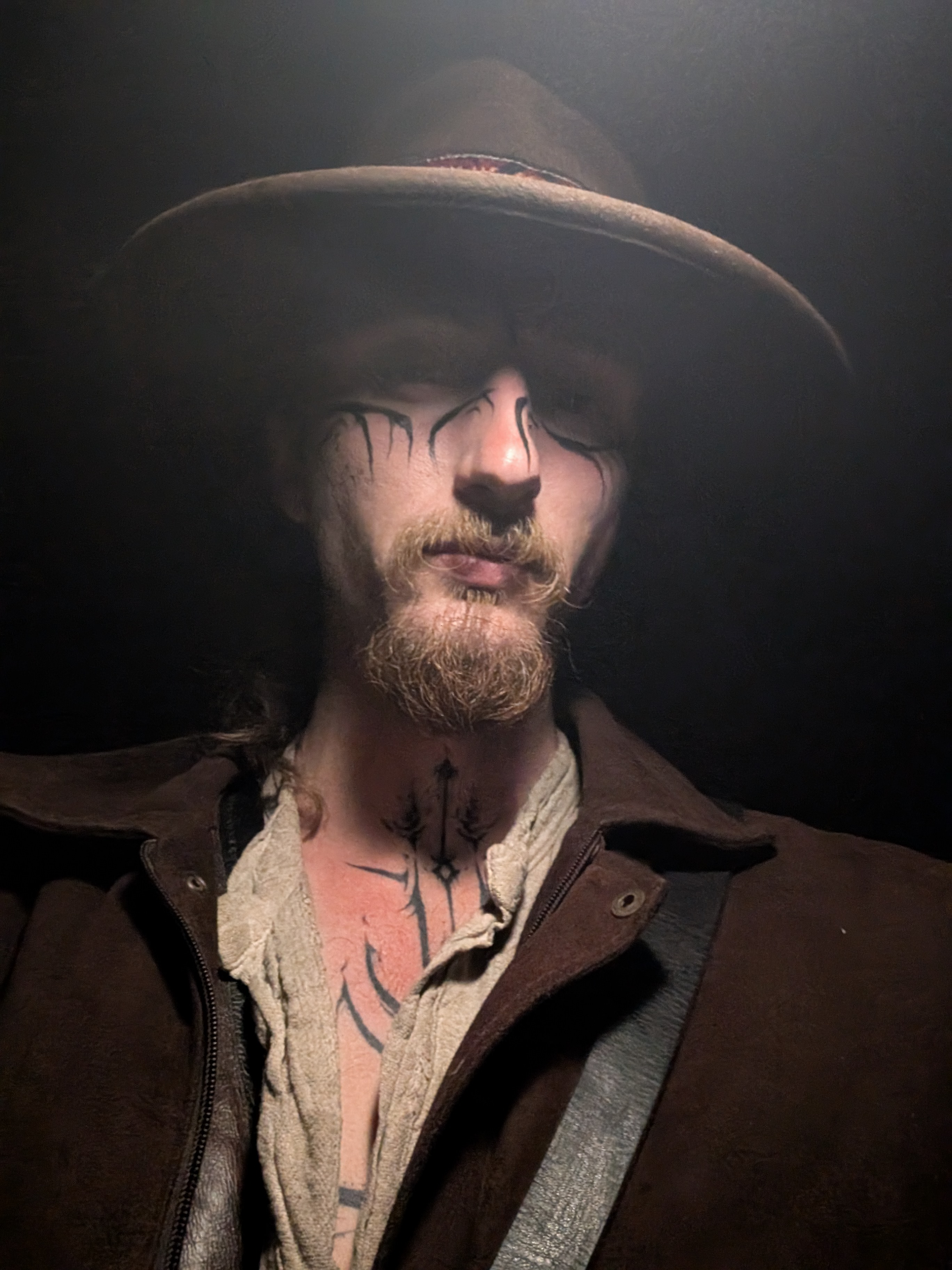
About the Work
The Beginning
Five years ago a very dear friend handed me a project — a leather martial arts punch bag that needed stitching together. They showed me the saddle stitch, told me to make a pattern and a prototype for future projects, and left me to it. That was the entirety of the instruction. What they gave me was not a skill but a method: begin, respond, learn from the material itself.
I have worked that way ever since.
The Process
When I begin a piece I usually know what I am making — a pouch, a bag, a pair of gauntlets, a grip for a fire staff — but I rarely know what it will look like when it is finished. It starts with intent, while the design emerges in real time.
I choose leather intuitively. One piece seems to call for another. I cut, layer, and draw freehand directly onto the leather — in most cases, permanent marks — where each decision informs the next. There is no fixed plan beyond the intention — only presence, listening, and response. It's less about thinking and more about feeling.
This is why the process feels meditative. You cannot rush toward the finished piece. You can only be with what is in front of you, follow where it leads, and trust that the next step will become clear when you arrive at it. Sometimes I spend as much time staring at the piece, listening to what it wants, as I do structurally making it. If it's not clear in that moment, I have to stop and come back to it later.
There are moments when a piece demands something I would rather not give it — a particular detail, an extra hour of stitching, a level of care that feels excessive. I have learned to follow those demands anyway. The piece knows what it needs.
I surrender to that process.
I'm sharing this because I care for the art and believe it has great gifts to offer us. This is not just me marketing my craft — I'm sharing an alchymic blueprint to inspire others. The more I have engaged with this process, the more refined it has become. As the creative practice is refined, so too is my Self. The patience, focus, creativity and all the other elements required for the craft transcends the craft itself and into all dimensions of life. This is one example of turning lead into gold; ignorance to understanding.
If this resonates and you want to know more — I am an open book. Reach out.
The Materials
I work with offcuts and recycled leather wherever I can. This is a small act of rebellion — against throwaway culture, against the assumption that beauty requires the pristine and the new. Magic can be found in all places. A piece of leather that has already lived one life can begin another. And unlike synthetic materials like silicone and plastic, leather will eventually biodegrade.
Not everything can be recycled though. The strips I braid for fire staff grips run fifty to seventy inches long — the full length of a hide — and that requires working from whole skin. But the intention is always there: use what exists, honour what the material already is, impose as little as possible.
Leather is a living material. It has its own history, texture, and individuality. Through the making process I try to preserve that quality rather than override it. The grain, the variation, the marks already present in the hide — these are not flaws to be hidden. They are what makes each piece real.
The Fire Props
Performance props are usually made from synthetic materials — heat-resistant plastics that feel cheap and degrade with practice. I believe the grip should outlive the wick. The life of a fire staff should be determined by how much fire it has consumed, not how much it has been handled. Practice without anxiety. Use the tool fully.
Leather-wrapped grips are not a new idea. This technique was used across the world in the medieval period — a craftsperson in the fourteenth century would recognise the method immediately. Yet in all my years as a fire performer, I have never seen a staff wrapped in leather. There is something right about this continuity.
Every staff made is unique and cannot be found anywhere else. I refuse to make copies. Each one is built for the hands that will hold it. If the staff is meant for you, you will know. If you absolutely want a staff but can't afford it, talk to me.
The Sigils
Probably the most difficult element to speak to. Inspired by ritualistic tattoo art, I began incorporating sigils into the work — symbols drawn both freehand and learnt through study, stitched into the leather, carrying an intention set during the making process and to be discovered by you.
Another reflection of alchemy: the transmutation of raw material into something that carries meaning beyond its function. A pouch becomes a key. A talisman becomes an anchor for the subconscious. A grip becomes an extension of the performer's will. A fire staff becomes a friend. A bag becomes a companion.
You rarely see hand-stitched sigils in leatherwork because the time involved makes it completely impractical commercially. I want them in the work anyway. I am happy to subsidise that.
What I Want You to Feel
I want you to feel that you are holding something real and alive.
Not just an object but something with spirit — made with care, intent, and a channelled state of awareness. Something that has been deeply considered, felt, and followed to its own standard.
The pieces are made to be used and lived with. I want them to feel like companions rather than possessions. I want the leather to soften with the oil from your skin, the stitching to become familiar, the sigil to catch your eye and anchor you into a state of observation and a state of remembering.
In a world of mass-produced objects, I want my work to encourage a different kind of relationship with the things you carry. Personal. Enduring. Alive with their own spirit.
I want you to feel the Alchymic process, without being able to fully explain what you're feeling.